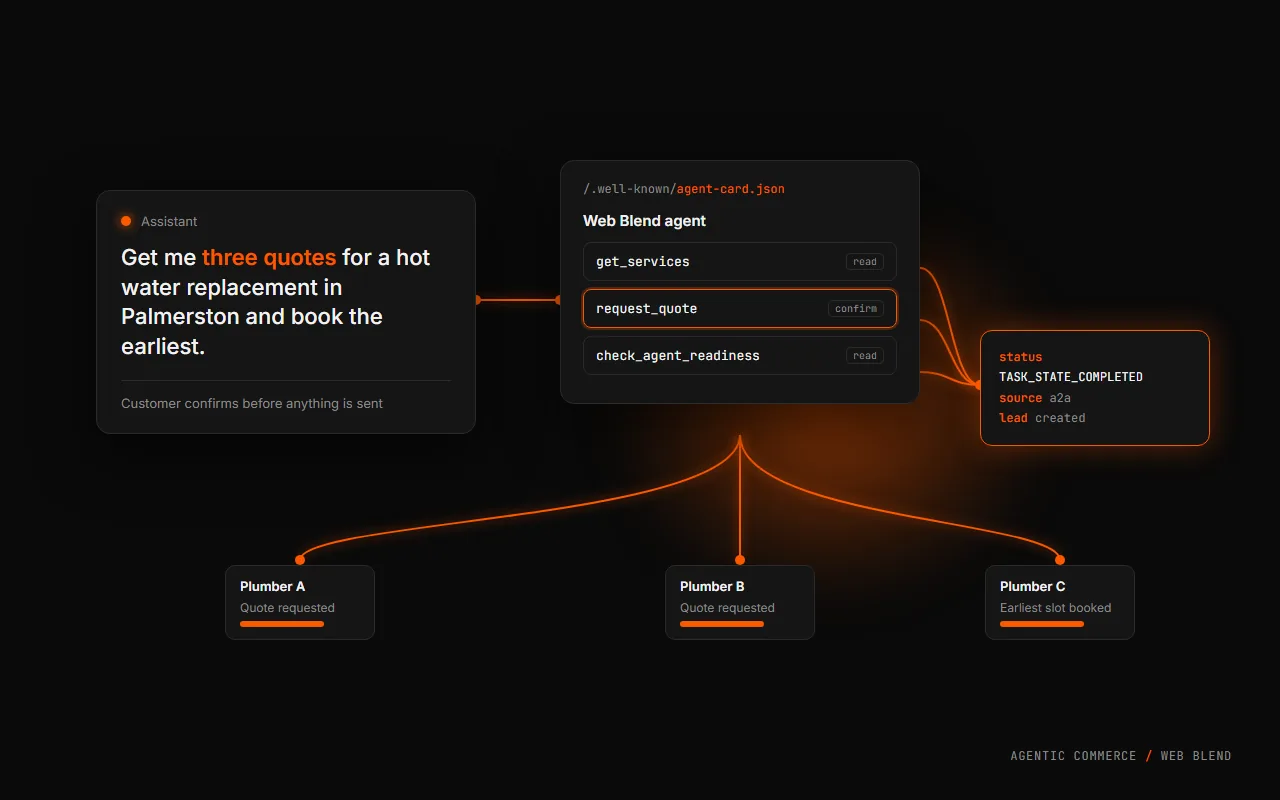

Agentic commerce means an AI assistant can help a customer find, compare and eventually book and pay for a service. For a trade business, the useful first step is making services clear and quote forms easy for people and agents to use.
- A homeowner's agent could compare local hot water installers, request quotes and book a suitable time, with the customer confirming key steps.
- llms.txt and clear service pages help discovery; labelled forms and experimental WebMCP make quote requests easier to complete.
- A2A connects separate agents, while Web Bot Auth helps sites identify signed automated visitors and set access rules.
- UCP, AP2 and ACP focus mainly on shopping and payments. A trade site usually needs a reliable booking path before payment protocols.
- Check Cloudflare's agent policy as well as the page itself: a blocked agent cannot use a technically ready site.
Keep asking about it in
Quick answer: Agentic commerce is when an AI assistant helps someone find, compare, book and sometimes pay for a product or service. For an Australian trade business, picture a homeowner in Palmerston asking an assistant: “Find three plumbers who can replace my hot water system, get quotes and book the earliest suitable visit.” Your site needs to tell that assistant what you do, where you work and how to request a quote. It does not need a shopping cart. The practical work starts with clear pages, usable forms and a firewall that lets legitimate customer agents through.
What agentic commerce means on a trade site
Today’s customer might search Google, open three tabs, make two calls and fill in a form. In an agentic journey, the customer gives an assistant the job. The assistant checks providers, compares their stated services and availability, and helps send the enquiry. Where the systems allow it, the assistant could complete a booking or a payment under the customer’s instructions.
For our Palmerston homeowner, a useful result is not three product listings. It is three relevant plumbers with a stated service area, an honest way to request a hot water quote, and a clear next step. The assistant still needs the customer to confirm the address, job details, appointment and any payment. A quote request is not a confirmed installation price. A booked inspection is not permission to charge for a replacement.
That distinction matters. Most trade jobs need a diagnosis, a site visit or a conversation before a firm price exists. The opportunity is to make that hand-off quicker and less error-prone, not to pretend every job can be bought off a shelf.
Discovery: let an agent find the right information
What it does: llms.txt is a proposed plain-text guide to a site’s useful pages. It can point an assistant to your services, locations, pricing guidance and contact route. It does not guarantee a mention in an AI answer or improve Google rankings by itself. Your normal pages still need accurate names, locations and details that a customer can read.
Do you need it now? It is cheap to publish and maintain, so yes, provided it matches the real site. A plumber serving Palmerston should not list Darwin suburbs they will not visit just to catch more enquiries. Put the same truthful service area on the relevant pages.
There is a second discovery file with a different job. Google’s Agentic Resource Discovery announcement on 17 June 2026 describes an ai-catalog.json file at a well-known path. It lists machine-callable capabilities, such as an MCP server, an A2A agent or an API, so another agent can find and verify them. It is not a replacement for your service pages or llms.txt.
Do you need it now? Only when your site has a real capability worth listing. A catalog that promises a booking tool which does not exist helps nobody. Start with the service information and quote path. Add the catalog when there is a working tool to discover.
WebMCP: make the quote form understandable
What it does: WebMCP lets a page declare actions as tools for a browser-based assistant. Chrome’s origin trial includes a declarative form approach: a form can have a tool name and description, with labels that explain each field. An assistant can fill in a quote request without guessing whether “location” means the job address or the owner’s address.
Do you need it now? You need proper form labels now. WebMCP itself is experimental, so treat it as a modest addition to a good form, not a reason to replace one that already works. Keep the person able to review the details before submission. Our WebMCP explainer shows the difference, and our free agent ready check checks the signals your site exposes.
There is an important boundary here. WebMCP acts on a page that is open in a browser. It does not make a hidden booking system available to every assistant on the internet. If your booking calendar cannot actually return available times, naming it as a tool will not create that function.
A2A: when one agent needs to talk to another
What it does: Agent2Agent, or A2A, gives separate agents a way to discover one another’s capabilities and exchange work. Google introduced it and transferred the project to the Linux Foundation. An Agent Card at /.well-known/agent-card.json can describe the agent’s skills and endpoint. This is different from WebMCP’s tools inside a customer’s open browser tab.
Do you need it now? Usually no. A local electrical contractor with a service page and a quote form has little reason to run an agent service. A2A becomes useful when there is something real for another agent to call, such as a live availability lookup or a reliable quote intake workflow. The card is a directory entry, not the service itself.
What we have done: webblend.au now publishes its own agent card at /.well-known/agent-card.json and answers A2A calls at /a2a. It offers three skills: list our services and prices, score any URL for agent readiness (the same check as our free tool), and lodge a quote request, which lands in our CRM the same way a form submission does. The site also lists that card in an ai-catalog file so directories can find it. We built it to learn what agents actually call, and every form on the site now carries WebMCP attributes as well. That is the groundwork we can now repeat on client sites when there is a reason to.
The names are easy to mix up. MCP, the Model Context Protocol, connects assistants to tools and data. WebMCP declares tools on a web page. A2A connects agents to other agents. They answer different questions, so a trade site does not need to install all three to be useful.
Identity and access: make sure the agent can get in
What it does: Web Bot Auth uses HTTP Message Signatures so an automated client can prove which operator signed a request. It is work in progress in an IETF working group, not a final W3C standard. A valid signature identifies the sender; it does not automatically prove that a particular customer authorised a booking or payment.
Do you need it now? You do not have to implement signatures on a small trade site. You do need to review the bot settings on the service that protects it. Cloudflare’s current AI bot controls distinguish agents acting for a person from search and training crawlers, and let site owners allow or block those categories. Cloudflare also treats signed agents as verified bots when they meet its identification and behaviour rules. Being verified does not mean every agent should get unrestricted access.
Cloudflare says its 15 September 2026 defaults for new domains block bots classified as Training or Agent on pages with ads, while Search remains allowed. That is a narrow default, not a claim that every trade site blocks agents. Check your own settings and security events. If your firewall challenges or blocks an assistant before it sees your form, perfect WebMCP markup will not help the customer.
UCP, AP2 and ACP: where payment fits
What they do: Google’s Universal Commerce Protocol, or UCP, announced in January 2026 with Shopify, Etsy, Wayfair, Target and Walmart, gives shopping systems a shared way to handle discovery, carts, checkout and orders. Its first examples centre on retail purchasing, though the protocol can support other use cases. It is a way to coordinate a transaction, not a source of job prices.
Google’s Agent Payments Protocol, or AP2, announced in September 2025, addresses proof that a person authorised an agent-led payment. Its signed mandates can tie permission to a particular purchase and amount. Google released AP2 v0.2 and donated the project to the FIDO Alliance in April 2026.
Agentic Commerce Protocol, or ACP, was developed by OpenAI and Stripe. It powers the Instant Checkout path in ChatGPT, where a shopper reviews and confirms a purchase and the merchant handles the order and payment. This is another commerce integration, not another name for AP2.
Do you need them now? Usually no for a plumbing, roofing or air-conditioning site. A fixed-price call-out may be bookable and take a deposit. A hot water replacement may need a site assessment before anyone can quote. If assisted payment becomes useful to trades, that booking and deposit step is a more plausible starting point than putting a full retail cart on a service site. That is a forecast, not a feature these protocols already deliver for every Australian tradie.
What to do now, in cost order
You can prepare without buying a new platform. Work through the basics in this order:
- Publish a truthful
llms.txt. Link to your main services, service area, pricing guidance and contact page. Keep it in step with the site. - Label every important form field. Make name, address, suburb, job type and preferred time unambiguous. Tell the customer what happens after they press Send.
- Review Cloudflare’s agent rules. Allow appropriate verified, user-driven agents while keeping controls for abuse and training crawlers. Test that legitimate requests reach the relevant pages.
- Declare the quote form with WebMCP. Give the action and its fields clear descriptions. Keep normal form validation and customer confirmation working.
- Add
ai-catalog.jsonwhen you have callable tools. List only endpoints that exist, work and have an owner who will maintain them. - Use A2A if an agent service has a useful job. A live service and a reliable hand-off come before an Agent Card.
The first four are part of how we build Living Sites, our approach to sites that keep improving after launch. Every site Web Blend builds ships with that groundwork. The later files and protocols depend on what the business can actually offer an agent.
What not to do
Do not bolt a cart onto a plumbing website to look modern. Do not pay for an “AI SEO” tool because it promises to rank you in assistants. No discovery file or protocol can rescue inaccurate service pages, a broken form, an unanswered phone or a blocked site. These are ordinary business problems with ordinary fixes.
There is no need to panic, either. Clear copy helps a homeowner decide whether to call. Proper labels help people using assistive technology. A stable quote flow helps anyone on a phone. Google’s search systems still need to reach and understand the same pages. Agent readiness is a useful extra reason to do that work well.
If you want a starting point, run the free agent ready check, then try requesting a quote on your own site as if you had never seen it before. If the customer cannot tell what to enter or what happens next, fix that first. Our Conversion Websites work builds those basics into the site from the start.