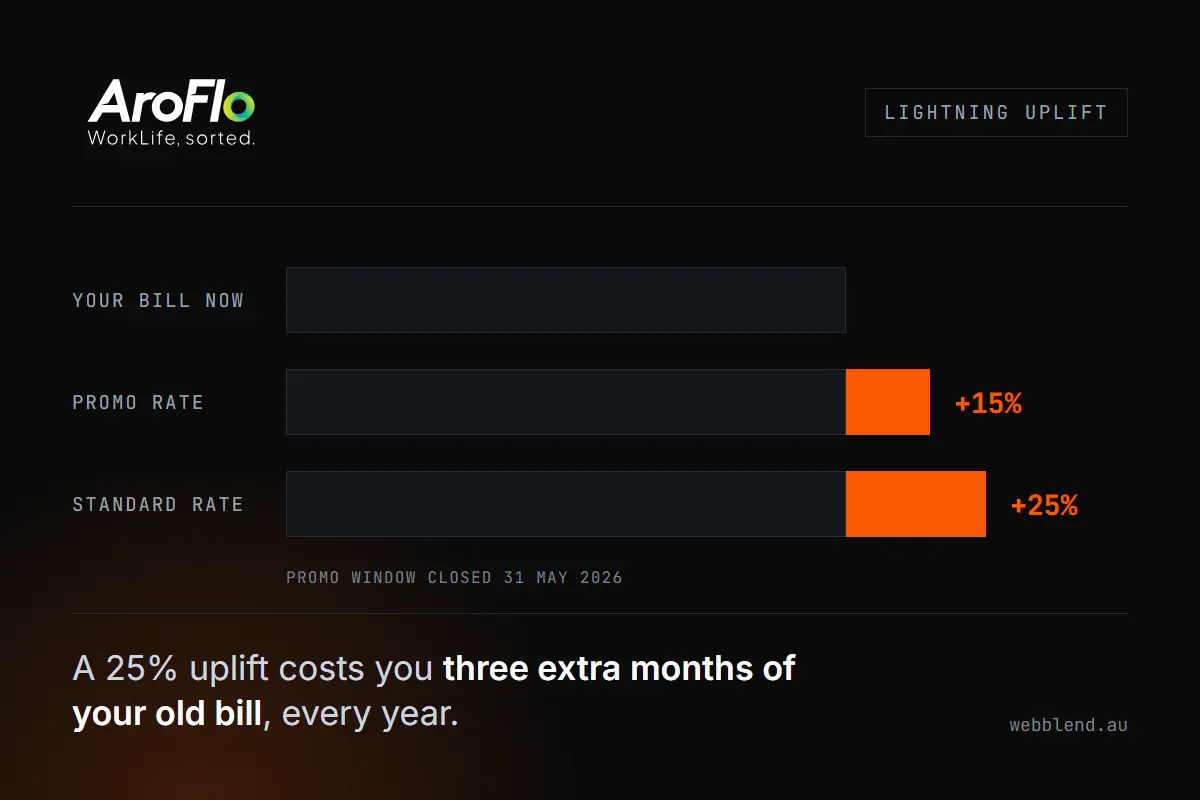

Simpro Group's launch announcement puts AroFlo Lightning at a percentage uplift on your existing contract, not a new price list: 15% during a window that closed 31 May 2026, and 25% after it.
- AroFlo's pricing page carried a full rate card in December 2025 and was price-free by June 2026. Every quote is now private.
- AroFlo's own blog still lists the old rate: $67 per user per month, a $335 monthly minimum, and onboarding from $2,900.
- On that $335 minimum, a 25% uplift adds about $84 a month. Whatever your bill, 25% a year costs you three months of it.
- The Price Lock Guarantee capping rises at CPI plus 3% is written for Simpro Lightning in the announcement. Get it in writing.
- AroFlo Lightning adds a fifth agent, JustAsk, on top of the four Simpro named at launch. Neither AroFlo page prices it.
Keep asking about it in
Quick answer: AroFlo Lightning is not a new price list, it is a percentage added to the contract you already have. Simpro Group’s launch announcement put it at a 15% uplift during a promotional window that closed on 31 May 2026, and 25% after that. Applied to the $335 monthly minimum AroFlo itself last published, that is roughly $50 or $84 more per month. The complication is that AroFlo has stopped publishing prices altogether, so the only number that matters is the one on your quote. Here is what is on the record, what is not, and the four things to get in writing before you accept the upgrade.
What is AroFlo Lightning?
Lightning is an AI layer that Simpro Group announced on 13 May 2026 and shipped across three products at once: Simpro Lightning in Australia, New Zealand and North America, AroFlo Lightning in Australia and New Zealand, and BigChange Lightning in the UK and Europe. The announcement describes it as available immediately to all Simpro, AroFlo and BigChange customers as a platform upgrade. The engine underneath is called Cooper, and Simpro Group is the parent company of Simpro, AroFlo, BigChange and ClockShark, so the same brain now sits across all of them.
Simpro Group named four AI agents at launch: FieldReady for technician training, JobReady for pre-dispatch briefing, JobScribe for capturing job notes by voice, and JobBrief for post-job customer summaries. AroFlo’s own Lightning page lists those four plus a fifth, JustAsk, which answers plain-language questions about your own data, alongside two-way messaging and GPS time tracking. So AroFlo Lightning is not a straight copy of Simpro Lightning, and a review of one is not a review of the other.
The July 2026 RAIN release added more, at no additional cost to existing Lightning customers. For AroFlo specifically, that release brought real-time schedule re-optimisation when a job is cancelled or an urgent call lands, and smart safety forms that read a photo of the workplace to identify hazards before work starts.
Worth saying plainly: the efficiency numbers attached to those agents, onboarding compressing from 12 to 16 weeks down to days, first-time-fix rates climbing from an industry average of 75% to 90% or higher, are Simpro Group’s own figures from its own launch announcement. They are not independent measurements, and as of August 2026 there is no independent review of AroFlo Lightning on the first page of Google. The first page of Google for “aroflo lightning” is AroFlo’s homepage, two of its own YouTube videos, and its Facebook and Instagram profiles. Nobody outside the company has published anything on it.
What does the upgrade actually cost?
The uplift is a percentage, so the dollar figure depends entirely on what you pay now. That makes AroFlo’s own last published rate the only sensible starting point.
AroFlo’s blog still lists AroFlo from $67 per user per month with a minimum monthly price of $335, and AroFlo Premium carrying an onboarding fee from $2,900, with add-ons like GPS tracking from $12 per device per month and an AI bill scanner at $25 a month.
Treat those add-on figures carefully, because AroFlo’s own pages did not agree with each other even before the prices came down. The archived pricing page from 13 December 2025, the last capture that still carried a rate card, lists “GPS tracking From $15 device/mo + Hardware” and the AI-Bill Scanner at $35 a month. That is the same vendor publishing two different prices for the same two add-ons. The archived page does back up the core rate the table below rests on: its tier slider quotes $680 a month for ten users, which is $68 each, alongside the same $335 monthly minimum and the same $2,900 onboarding fee.
Capterra Australia lists a starting price of $39 per user per month, which appears to reflect the lighter AroFloGo product rather than the full platform.
Take the $335 minimum as a floor and run the uplift across three business sizes. This is an illustration built on AroFlo’s published rate, not a quote.
| Your AroFlo bill | Now, per year | At 15% uplift | At 25% uplift | Extra per year at 25% |
|---|---|---|---|---|
| $335/mo (the published minimum) | $4,020 | $4,623 | $5,025 | $1,005 |
| $670/mo (about 10 users at $67) | $8,040 | $9,246 | $10,050 | $2,010 |
| $1,340/mo (about 20 users at $67) | $16,080 | $18,492 | $20,100 | $4,020 |
The shortcut worth remembering is in the last column. A 25% uplift costs you three extra months of your old bill every year, forever, whatever your bill is. A 15% uplift costs about 1.8 months. That is the number to weigh the four agents against, not the monthly difference, which always sounds small.
If you are taking the upgrade, treat it the way you would a rise in insurance or vehicle costs and push it through your hourly rate. Our charge-out rate calculator will show you what an extra $84 or $167 a month does to the rate you need to charge to hold your margin.
AroFlo has stopped publishing its prices
This is the part that changes how you should read everything else, and it has been true for months while the search results have stayed exactly where they were.
The Internet Archive dates it. Its capture of 13 December 2025 is the last one that still carries a full rate card: a tier slider, a minimum monthly price of $335.00 and uncontracted users charged at $81.00 per month. The next capture, on 12 June 2026, has no dollar figure anywhere on the page and a “Request Pricing” button where the rate card used to be. So the change landed somewhere in that window, which means the page had been price-free for at least eleven weeks by the time this was written, and possibly a good deal longer. The pages ranking on Google today still quote the old numbers. That is not a gap that is about to close on its own.
AroFlo’s pricing page no longer shows a price. As at 31 August 2026 it lists a single tier, AroFlo Premium, with its inclusions, and a “Request Pricing” button. No per-user rate, no minimum, no tier comparison. Every quote is now a private negotiation, which is exactly the position Simpro customers have been in for a while, and it is the reason we had to write a whole guide to what Simpro actually costs instead of just linking a rate card. AroFlo’s own blog even says of Simpro that “to discover Simpro’s pricing options, it’s best to contact the team as these are not publicly available”. That is now true of AroFlo too.
The practical effect is that the third-party pages you will find still quote the old rates. Directory listings, comparison sites and Google’s AI Overview all cite per-user figures that AroFlo itself no longer publishes, starting at $39 a month and running past $200 at the top of the range. Those numbers were real. They are just no longer the thing you will be offered, and you cannot use them to check whether your quote is fair.
The same goes for the Lightning page. It carries an “Upgrade Now” button and no price anywhere on it. If you are being asked to upgrade, the percentage in the launch announcement is the only public figure that exists, and your account manager holds the rest.
Is the Price Lock Guarantee actually yours?
Read the announcement’s pricing paragraph carefully, because it changes register halfway through.
It says Lightning is available immediately to all Simpro, AroFlo and BigChange customers. Then, on the guarantee, it says Simpro Lightning also includes the Price Lock Guarantee, with annual increases contractually capped at CPI plus 3% for the life of the agreement. The release names all three products separately elsewhere, so the switch from “all three” to “Simpro Lightning” in the sentence that carries the contractual promise is worth noticing.
It probably applies to you. Coverage of the July RAIN release quotes Fred Voccola, Simpro Group’s Chairman and CEO, describing “our Lightning Price-Lock Guarantee” as capping any annual increase at no more than 3% above inflation for the life of the agreement, framed as a platform-wide policy rather than a Simpro-only one. But “probably applies” is not a contract term. Ask for the clause, in your agreement, naming AroFlo Lightning. If it is genuinely a cap, nobody will mind writing it down.
Also work out what the cap is worth to you. If Australian CPI runs at 3%, a CPI plus 3% cap is a 6% rise a year, which compounds. The announcement sets that against roughly 30% to 50% annual AI inflation across the SaaS industry. That framing is Simpro Group’s, and it is a comparison to software vendors generally rather than to what AroFlo would have charged you anyway.
Four things to get in writing before you click Upgrade Now
The dollar figure, not the percentage. Ask what your monthly bill becomes, in dollars, including GST, and what it was before. A percentage of a number you have never seen printed is not a price.
Which rate you are being offered. The 15% promotional rate was tied to a window that closed on 31 May 2026. If you are being offered 15% now, get the reason in writing. If you are being offered 25%, that is the announced standard rate and there is nothing irregular about it.
The Price Lock clause, naming your product. Which index, measured when, plus what percentage, capped or expected, and for how long. The announcement says “for the life of the agreement”, so check what the agreement’s life is.
What happens if you say no. This is the one people forget. Ask what your renewal looks like if you stay on AroFlo without Lightning: same price, an ordinary increase, or a product that stops getting features. The answer tells you whether this is an upgrade or a migration with a longer runway.
What if you would rather not be here at all?
Switching from AroFlo to Simpro is not an exit, because Simpro Group owns both, and Lightning is rolling out across both. If your goal is to leave the group, these are the AU options that still publish their prices.
| Pricing model | Published pricing | Contract | |
|---|---|---|---|
| ServiceM8 | Per job, unlimited users | Yes | Month to month |
| Tradify | Per user, unlimited jobs | Yes | Month to month |
| Fergus | Per user, tiered | Yes | Monthly, no lock-in |
We compared the first two properly in ServiceM8 vs Tradify, and there is a longer look at Tradify on its own. None of them matches AroFlo on project management, Gantt charts, multi business units or inventory depth. If you run big commercial jobs across several crews, AroFlo may well be worth the uplift, and the honest version of this article says so.
For transparency: Web Blend is a ServiceM8 partner. We build automations and integrations on it, including a ServiceM8 Google Drive integration. We have a commercial interest in that ecosystem, which is why every vendor above links to its own pricing page rather than to our summary of it.
The part nobody quotes you a price for
Simpro Group says more than 24,000 trade businesses and 450,000 users run on its platforms. AroFlo’s Lightning page says over 250,000 users worldwide. Those are big numbers, and they explain the shape of the deal: when a vendor is that large and its prices are private, the negotiation happens on their terms and your only real leverage is the credible ability to leave.
Software leverage is hard to build. Lead leverage is not. A trade business whose work comes through a website, a Google presence and a customer list it owns can absorb a 25% software uplift, or walk away from it, without the year wobbling. A business renting both its leads and its software is negotiating everything from the weak side of the table, which is the argument we make at length in buying leads versus generating your own.
Take the upgrade or don’t. Just make sure the thing you are locked into is the software, and not the software plus the source of every job you win.